Sunlight and Moonlight. On consciousness, the unconscious, and two ways of seeing.
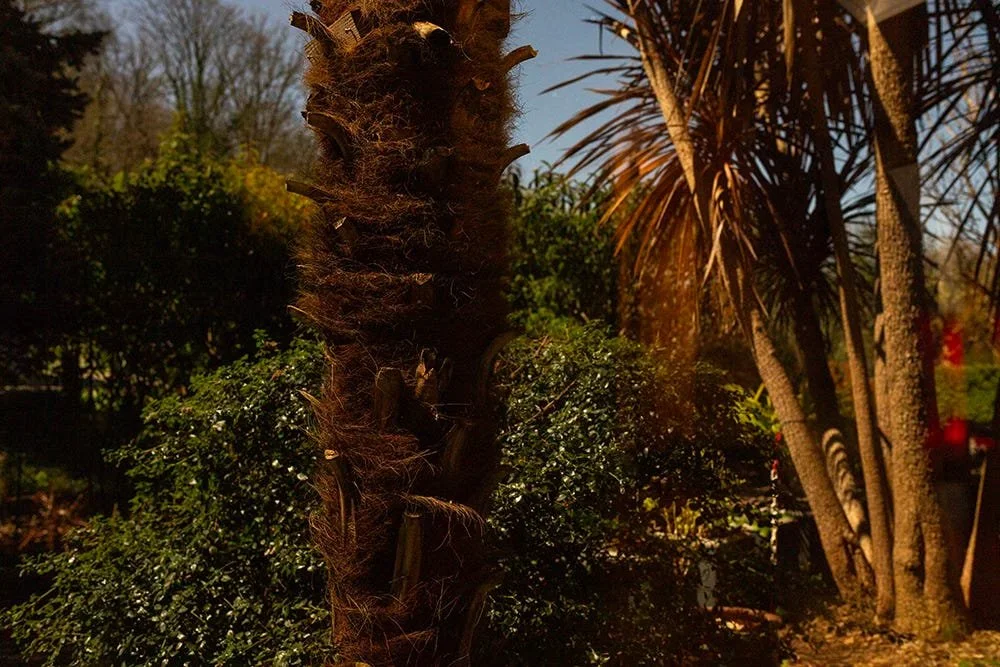
Photo © 2026 Yury Li-Toroptsov
I took this photograph in a garden that, at first glance, seems ordinary, almost neutral, as if nothing in the image demanded attention, as if it were simply another quiet fragment of landscape captured without intention.
Yet the image is not what it seems.
What looks like a day scene is in fact a night scene, produced through a very long exposure during which my camera slowly collected the faint light of an almost full moon, accumulating over time what the human eye cannot perceive in a single instant, until night began to resemble day.
If the result appears identical, one might ask where the difference lies.
The difference lies in the nature of light.
Daylight comes from the sun, direct, powerful, decisive, a light that strikes objects and defines their contours, a light that clarifies by separating and naming, and for this reason it has often been associated with consciousness, with the capacity to see clearly, to act, to decide, to impose order on reality.
Moonlight belongs to another order, because it does not originate from itself but from reflection, because it is weaker, slower, indirect, a light that does not strike but envelops, that does not impose meaning but allows meaning to emerge gradually, and in this sense it resembles the unconscious, not as darkness opposed to light, but as a different mode of illumination, one that reveals depth rather than clarity.
The long exposure of the photograph is therefore not only a technical choice but a symbolic gesture, because it shows that what cannot be seen immediately can become visible when time is allowed to work, when attention is prolonged, when perception is no longer governed solely by speed and efficiency.
A garden under the sun is readable and functional, whereas the same garden under moonlight becomes a space of projection and resonance, a landscape where memory, imagination, and inner life silently unfold, reminding us that human experience does not take place only in the realm of direct light but also in the realm of reflected light.
We need the sun to act and orient ourselves in the world, but we also need the moon to perceive what escapes conscious control, to sense what cannot be grasped through clarity alone, to access layers of meaning that appear only through slowness and indirectness.
If our lives were illuminated only by sunlight, everything would be visible but nothing would be deep, whereas without moonlight, everything would be deep but nothing would be articulated.
So what kind of light guides your way of seeing, the light that strikes, or the light that slowly reveals?