Winter Olympics at Milano Cortina 2026: Fire, form, and the search for a center
Symbolic reading of the Milano Cortina 2026 Olympic cauldrons
In the state of the world we are witnessing right now, collective rituals gain a special importance. Wars, geopolitical fractures, and permanent tension weaken shared reference points. In such moments, the Olympic Games take on a different role. They function as a rare moment when millions of people attend to the same gesture and the same symbol.
While watching the opening ceremony of the Winter Olympics Milano Cortina 2026, one element held my attention longer than the others. The cauldrons hosting the Olympic flame. Their form carried meaning before any commentary attempted to explain it.
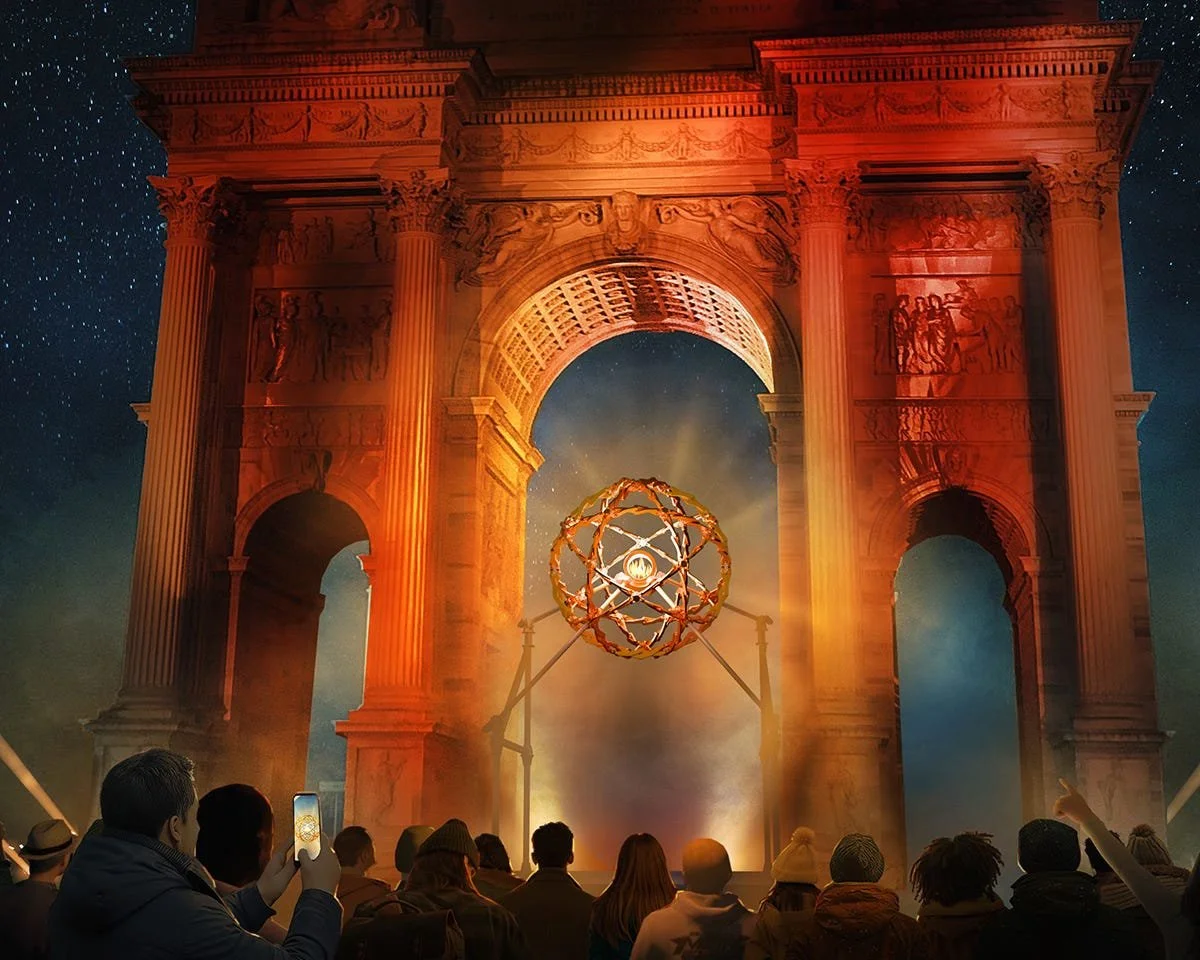
Source: Press kit @olympics.com
The cauldrons were designed by Italian designers and engineers working under the official organizing committee, with a clear intention to anchor the object in Italian cultural heritage while avoiding nostalgia or spectacle for its own sake. Their ambition focused on continuity, legibility, and shared meaning rather than power or dominance. The result avoided vertical monumentality and instead adopted a circular, interlaced structure inspired by Leonardo da Vinci’s knots.
Leonardo’s knots belong to a body of work where drawing served thinking. These interlaced forms consist of a single continuous line, folding back into itself without rupture or hierarchy. There is no privileged starting point, no final resolution. Each loop holds because another loop supports it. The image expresses a vision of reality structured by relation rather than separation.
For Leonardo, such forms reflected the logic of nature itself. Water currents, anatomical systems, and mechanical forces obeyed similar principles of flow and interdependence. By grounding the Olympic cauldrons in this motif, the designers proposed a quiet statement. Stability arises from connection. Strength grows through relation.
At the same time, the cauldrons unmistakably read as mandalas. Their circular geometry organizes complexity around a center, where the Olympic flame burns. Across cultures, mandalas serve as images of orientation when external order weakens. They gather multiplicity into a coherent form without erasing tension.
This dimension becomes clearer through a Jungian lens. For Carl Gustav Jung, mandalas appeared repeatedly in the drawings and dreams of patients undergoing periods of inner disorganization. He observed that when conscious structures fail to manage complexity, the psyche produces centering images spontaneously. The mandala functions as an image of psychic self-regulation.
In Jungian psychology, the mandala represents the Self, the organizing principle of the psyche beyond the ego. It does not promise harmony or perfection. Conflicts and opposites remain present, yet they are contained within a form capable of holding them together. The mandala offers orientation rather than resolution.
Seen from this perspective, the Milano Cortina cauldrons resonate beyond design or heritage. They respond to a collective psychological need. In times marked by anxiety and polarization, societies too search for centering symbols. The Olympic flame placed at the heart of a mandala-like structure speaks of containment rather than conquest, of care rather than triumph.
Jung insisted that symbols do not resolve conflicts through argument or instruction. They work indirectly. They allow contradictions to coexist without forcing premature closure. In a world shaped by escalating violence and binary narratives, the mandala does not deny fracture. It affirms the possibility of holding differences within a shared structure.
This is where the cauldrons gain their quiet force. They do not offer optimism as slogan. They propose a form of hope rooted in structure. The fire remains alive because it is contained. It warms rather than consumes. The circle holds, not because tensions vanish, but because a center endures.