The Charcoal You Didn’t Pick Up. How fear shapes choice, and how a simple gesture can begin to shift it.
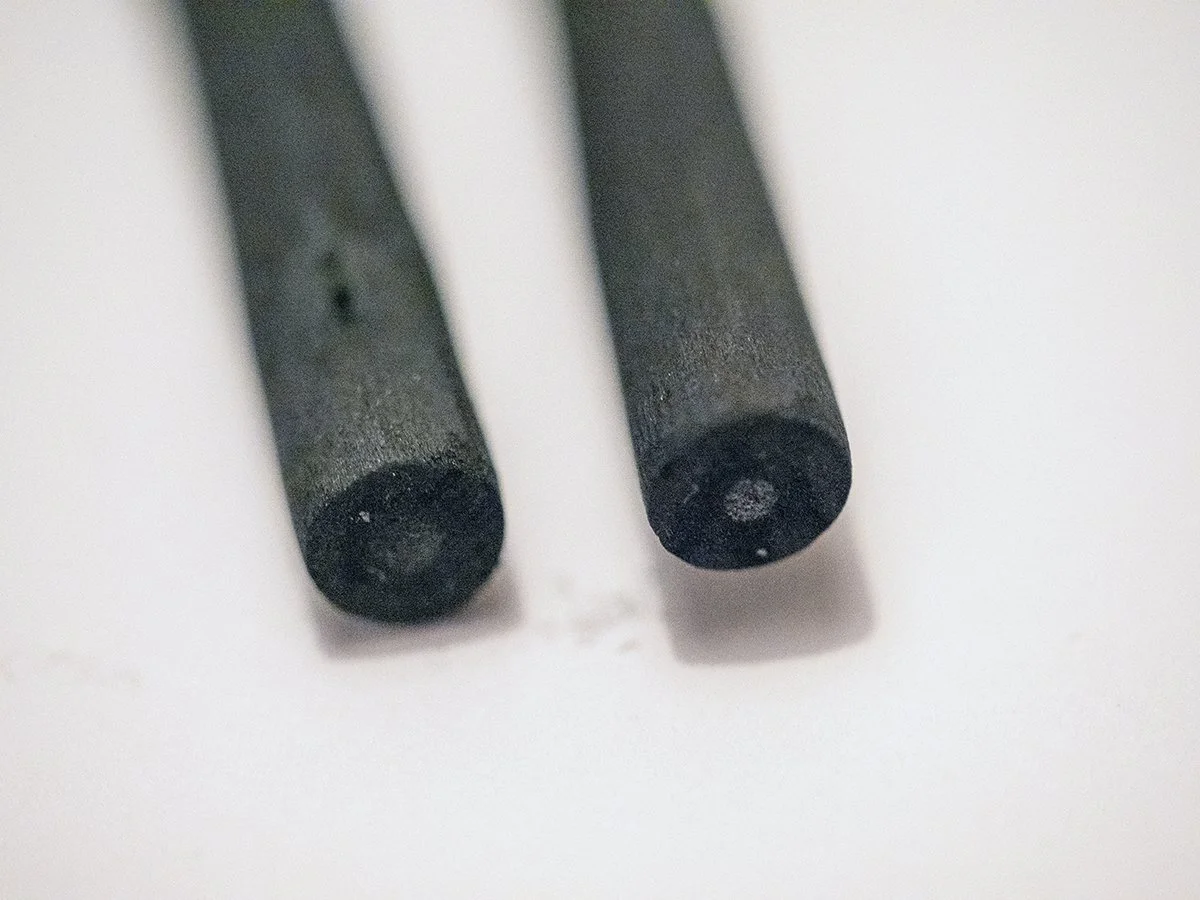
Photo © Yury Li-Toroptsov
During one of my recent workshops on symbolic thinking, I invited participants to make a spontaneous drawing, and on the table lay three simple options, pastels, felt pens, and charcoal, each offering not only a different texture but a different way of entering into relation with the blank page, a different rhythm of gesture, a different tolerance for uncertainty.
After the workshop had ended and the room had begun to empty, one participant lingered behind, and as she approached me she lowered her voice slightly, as if what she was about to say required a certain intimacy, and she told me that she had wanted to try the charcoal, that something in it had attracted her from the beginning, and yet she had never held charcoal before, and so she did not dare, and instead she had chosen a felt pen, she had made her drawing, and everything had gone well, everything had remained within the bounds of what she already knew how to do.
What stayed with me was not the choice itself, which in many ways was entirely reasonable, but the tone in which she spoke, something that was not regret and not quite disappointment either, something quieter and more difficult to name, as if a small internal movement had been interrupted at the very moment it was about to take form, leaving behind the faint trace of an experience that had not quite come into existence.
There is something archaic in charcoal, something that precedes technique and even intention, because charcoal belongs to the earliest gestures of human mark making, to those moments when a hand first pressed a dark fragment against a surface in order to leave a trace, not yet in the name of art but in the simple affirmation of presence, and to hold it today is, in a discreet but tangible way, to reconnect with that gesture, to enter into a continuity that exceeds individual skill or confidence.
At the same time, charcoal refuses neutrality, because it smudges, spreads, stains the fingers, and leaves traces beyond the line one intended to draw, and in doing so it creates a form of engagement in which one cannot remain entirely clean or distant, as if the medium itself required a certain implication from the person holding it.
Within its apparent simplicity, charcoal also reveals a surprising richness, because what appears at first as a single black unfolds into a range of tones and densities, from deep, velvety black to the faintest grey, and learning to perceive these differences already shifts attention away from control and toward a more nuanced way of seeing.
In the language of alchemy, this domain of blackness has long been associated with what is called Nigredo, the initial phase of transformation, a phase often misunderstood because it appears as dissolution or loss, while in fact it forms the necessary ground from which any transformation can emerge, and in that sense charcoal seems to carry within it an invitation to begin in uncertainty, to accept a first gesture that is neither precise nor fully controlled, and to recognize that this is not a failure of the process but its condition.
What prevented this participant from reaching for the charcoal was not the fear of failure in any explicit sense, because there was no evaluation, no judgment, no consequence attached to her choice, and yet something held her back, and it is precisely here that one begins to understand how fear operates, not as a dramatic force but as a subtle modulation of action, a slight hesitation that redirects us toward what is already familiar.
This form of fear rarely presents itself as fear, and instead takes the form of reasonable thoughts that justify remaining within known territory, and because these thoughts appear rational they often go unquestioned, even though beneath them lies a reluctance to expose oneself to the experience of not knowing what will happen next.
Over time, these small moments accumulate, not in ways that are immediately visible but in the gradual shaping of what one does not attempt, what one leaves aside, what one quietly avoids, and the result is not a dramatic limitation but a subtle narrowing of the space one inhabits.
If fear cannot be removed, then the question becomes how one positions oneself in relation to it, and this is where courage appears, not as the absence of fear but as a different way of responding to it, a capacity to act while uncertainty remains, without waiting for it to resolve itself beforehand, and this shift often takes place in moments so small they are almost invisible, such as the decision to reach for charcoal instead of the safer tool.
Most of what transforms a life does not occur in spectacular events, but in these modest displacements, where one allows oneself to step slightly beyond the edge of what is already known, because it is there that perception sharpens and something new has the possibility of emerging.
I often return to that moment in the workshop, not because of what happened, but because of what almost happened, because it is in these near moments that something essential becomes visible about the way we negotiate with ourselves and about the thresholds we hesitate to cross.
Perhaps she will pick up charcoal another day, and perhaps in doing so she will simply discover what it feels like to engage with something that does not immediately respond to her intention, and in that experience there may be a slight shift, enough to open a space that was previously closed.
And perhaps this is enough, because the question is not to eliminate fear or to transform everything at once, but to recognize these small points of hesitation and to see in them the beginning of a possible movement.