Photo © Yury Li-Toroptsov
I will begin with the confession of a very simple joy. Hilma af Klint has arrived at the Grand Palais, and I am happy to see her there. Before reaching this prestigious place, the exhibition had already traveled the world and proven itself, having begun at the Guggenheim Museum in New York, where it had drawn record crowds and quietly rearranged the furniture of art history. Paris, in other words, is not discovering af Klint, Paris is at last receiving her.
This is not an exhibition like the others. Af Klint does not belong exactly to the category of art brut, but she set herself the task of exploring something that French society long relegated to the strictly private sphere, namely spirituality as one of the dimensions of the psyche. My question, as I walked beneath the glass ceiling of the Grand Palais, was therefore naturally this one. How will the French know what they have before their eyes as they look at af Klint's creations? How would the curators choose to present her?
The answer, one observes, is that they chose art history as their guiding standpoint. The wall texts and the catalogue speak of a body of work that "overturned the chronology of modern art," making of af Klint a precursor of abstraction, she who painted her great non-figurative cycles years before Kandinsky, Malevich, or Mondrian. The exhibition also "interrogates" the "long-overlooked role of women in the history of modern art," restoring to a woman her place within a canon that had reserved none for her.
These are very important angles. But I keep asking myself in what way they help us decode the works themselves. What exactly allows us to penetrate beyond the paper and the canvas covered in tempera? A revised chronology of modernism? Chronology tells us when she painted, it does not tell us what she painted, nor why a Swedish woman, guided by what she experienced as commissions coming from higher intelligences, produced hundreds of works that she herself believed her contemporaries were not ready to see.
Is it by chance that, alongside af Klint at the Grand Palais, the Musée du Luxembourg is devoting an exhibition to Leonora Carrington, whose artistic practice can, in certain respects, be compared to a spiritual quest? Are the French, hard and pure Cartesians, aware of this irruption of the unconscious into their most illustrious institutions? I say this with irony, of course, but I truly believe that things are changing, and that the notion of spirituality, and I am not speaking of religion, so carefully evacuated from the Western psyche, is returning to it through a small door.
What I am certain of is that without a psychological reading in the etymological sense of the term, that is to say psyche (soul) and logia (study), and I am not speaking of psychopathology, it is difficult to grasp the meaning of what stands before us, displayed on the walls of museums. The angles chosen by the curators open the door of the exhibition, but they leave us on the threshold of the images.
It is this threshold that I would like to cross. I propose a reading in analytical psychology, a Jungian reading, of a small suite of four paintings belonging to the Dove series, an ensemble of works that summons the figure of Saint George and his combat with the dragon, and which has, I believe, far more to tell us than any chronology could ever contain.
The Dove Series (Duvan)
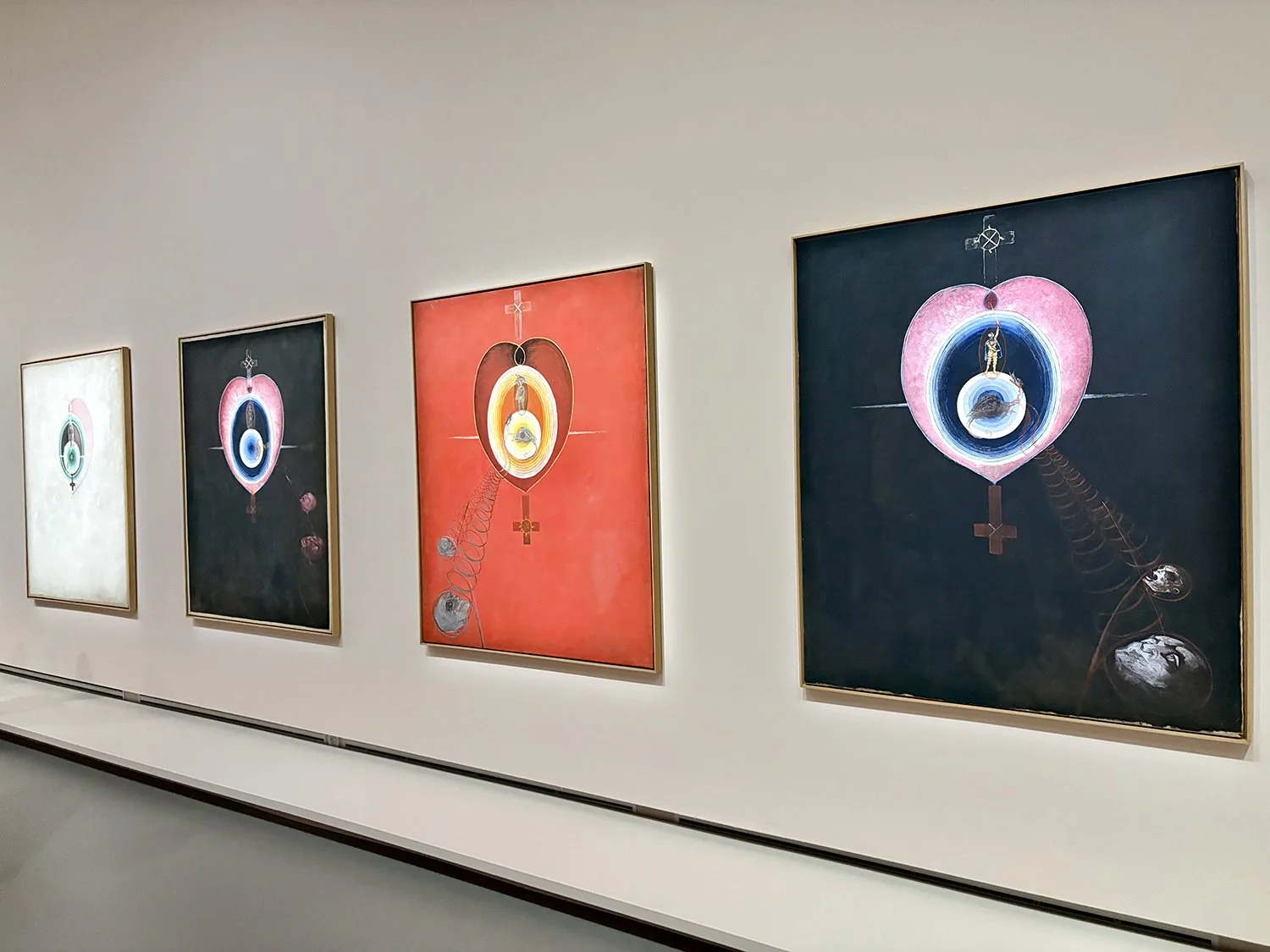
These four paintings belong to the Dove series (Duvan), group IX/UW, which Hilma af Klint undertook in 1915, in the immediate wake of the Swan series, and which constitutes one of the last ensembles of the Paintings for the Temple, that monumental cycle of nearly two hundred works that she carried out in response to what she experienced as a commission coming from higher intelligences. They are oils on canvas of substantial format, held today by the Hilma af Klint Foundation in Stockholm, of which four, the ones that concern us here, give to see, amid the abstract forms and symbolic colors that dominate the series, a clear and almost naive figuration, that of a knight and a dragon, in other words the combat of Saint George.
The date of 1915 is not a detail. In the first years of the Paintings for the Temple, af Klint painted under a guidance she described as involuntary, her hand led, she said, by the Masters who spoke through her. By 1915, that time is past, and she now works in a conscious, reflective, constructed manner, while remaining in dialogue with the spiritual world, nourished in particular by the anthroposophy of Rudolf Steiner. For the Jungian reader, this evolution has a name. It corresponds to the passage from possession by unconscious contents to what Jung would later call active imagination, that is to say a conscious ego that no longer undergoes the images but enters into relation with them, questions them, answers them. The Dove paintings are therefore not mediumistic dictations, they are the traces of a confrontation.
And this confrontation has a face. Af Klint herself notes in her notebooks that Saint George is one of her alter egos, while the dragon, that winged serpent saturated with symbolism, embodies the darkness that must be struck down. In other words, the artist is not painting a golden legend, she is painting herself. The combat of the knight and the monster, which unfolds progressively across the series like the stations of a path, is her own, and the fact that certain commentators see in the knight a woman in armor only thickens the question of who, within her, is fighting, and who is being fought. The series as a whole frames this duel with two motifs that designate its true site, the heart on one side, present from the very first painting with the circle and the double spiral, the cosmos on the other, with the metallic planets of the last canvases, so that the battle is waged between the heart and the stars, which is to say nowhere other than in the psyche.
It is here that the Jungian reading finds its method. It consists in taking the image seriously as a psychic fact, in not reducing it to a biographical document nor, still less, to a symptom, but in amplifying it, that is to say in setting it in resonance with the comparative treasury of myths, tales, and religious iconography, in order to hear what the image says of itself. The myth of Saint George lends itself to this admirably, for it is one of the great Western formulations of what Jung names the combat of the hero against the dragon, that struggle of the nascent ego against the forces that threaten to engulf it, and that liberation of what the monster holds captive. Let us now look at the four paintings, one by one.
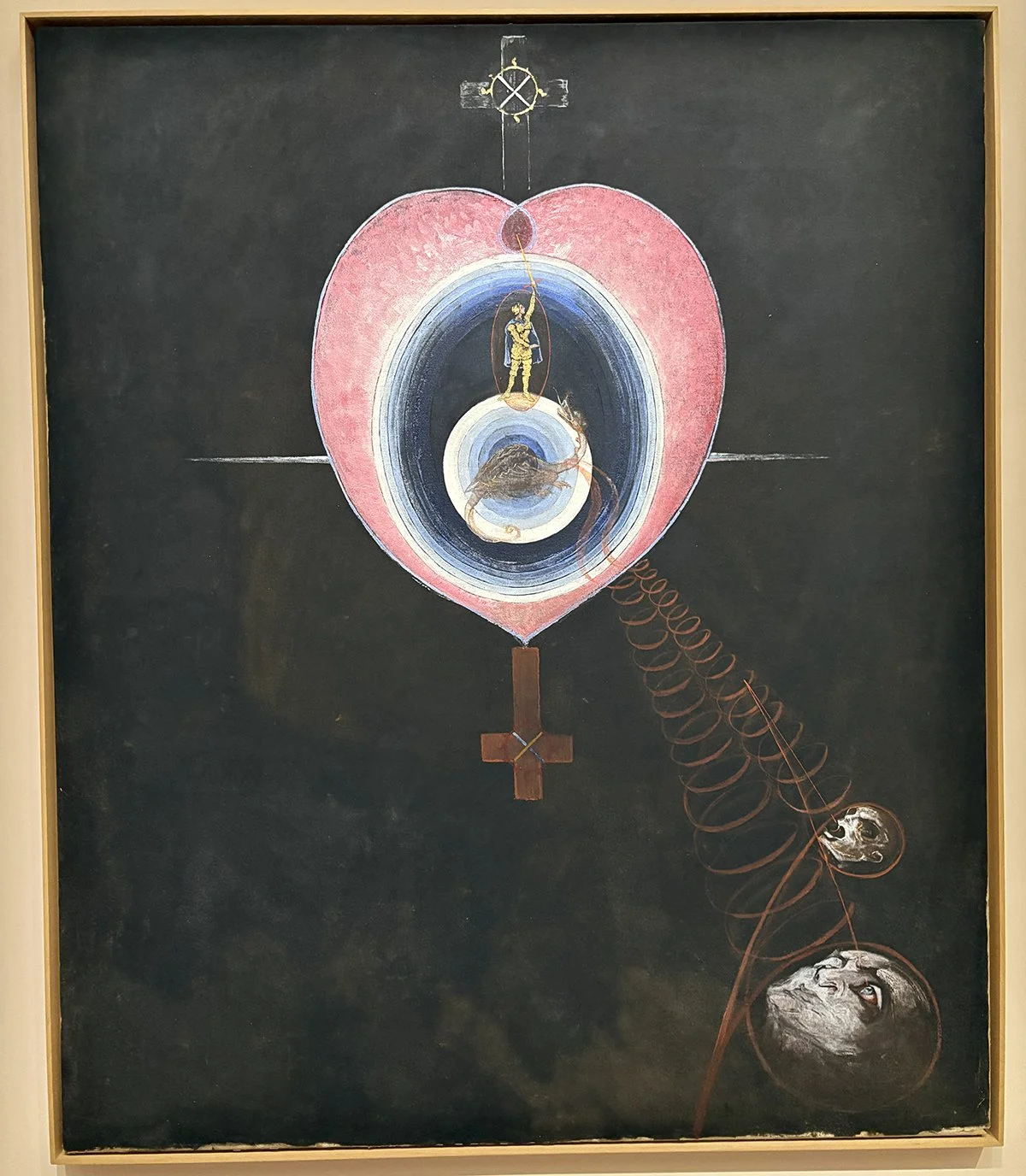
Photo © Yury Li-Toroptsov
The first painting seizes us at once by its night. Within a deep black that occupies almost the entire canvas there floats a great pink heart, opened onto a well of concentric rings, and at the bottom of that well unfolds the scene of a minuscule golden knight, his blade raised, standing above the dark-winged dragon, while a spiral escapes from the heart and descends toward two severed heads that gaze at us from the shadows of the lower corner.
What we have before our eyes is not an illustration of the golden legend, it is the representation of a psychic state. The combat does not take place before a city, as in Carpaccio or Raphael, it takes place within a heart, which is to say within. Af Klint paints the moment when the ego, the center of consciousness, that infinitesimal flicker of gold in the midst of the black immensity, confronts the unconscious, and this confrontation is a merciless battle, for the dragon is struck down and yet its heads, expelled from the heart, remain suspended from it by the spiral, as though to remind us that nothing which is vanquished in us ever truly disappears. This is precisely what Jung calls the process of individuation, which is not a peaceful unfolding of the personality but a struggle, one in which consciousness must hold its own against the forces that threaten to engulf it, and in which each victory displaces the shadow without ever abolishing it. The painting speaks of the unequal grandeur of this combat, a minuscule ego and an oceanic unconscious, and it speaks also of its possibility, since the knight is standing, at the center, and his blade does not fall but points upward.
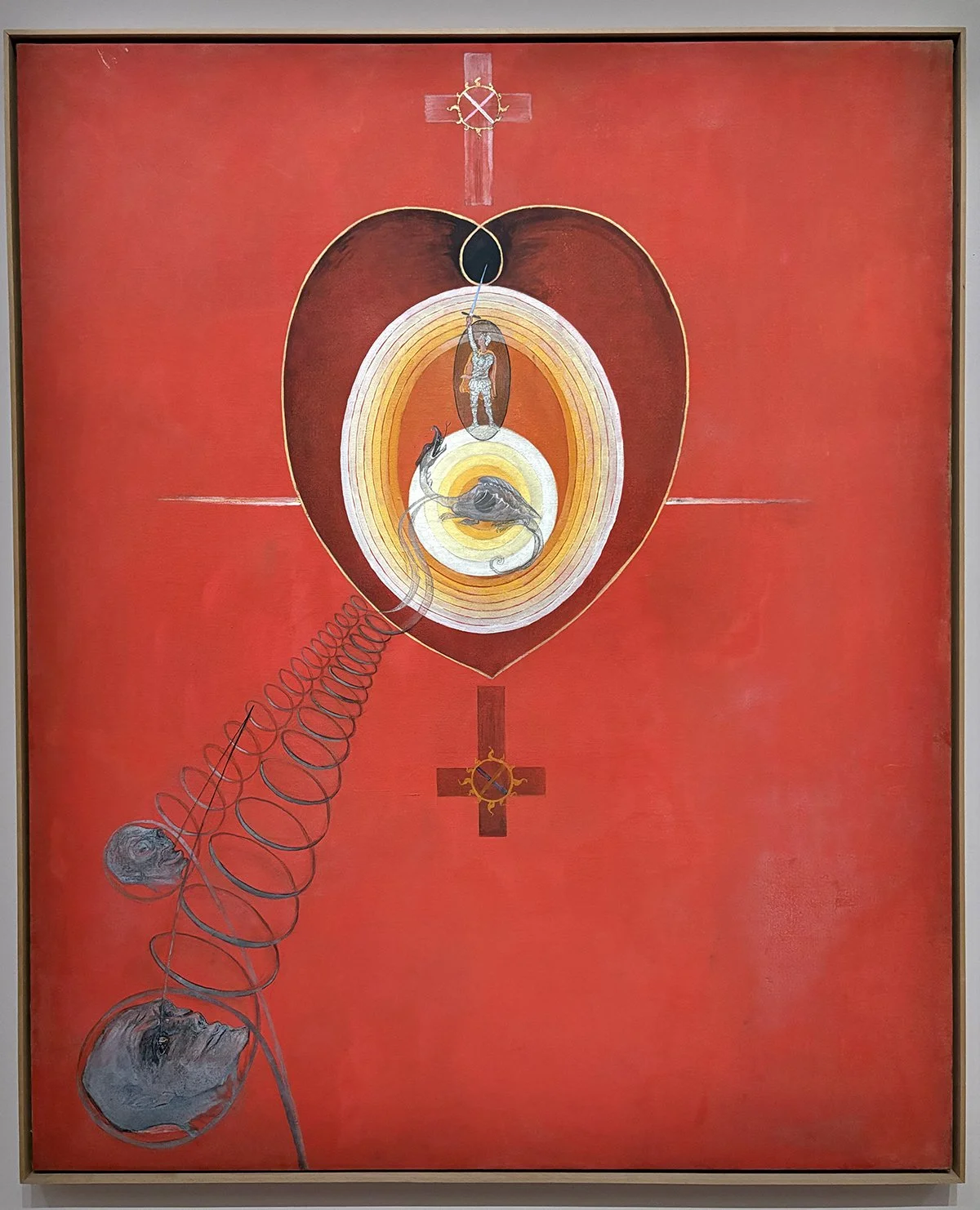
Photo © Yury Li-Toroptsov
The second painting takes up the same architecture, the heart, the knight with his raised blade, the dragon, the spiral and the two severed heads, yet everything has changed in color, for the black has given way to an intense red that invades the entire canvas, while the spiral and the heads have migrated to the left side, as though in a mirror of the first painting.
This passage from black to red is surely no caprice of the palette. The alchemists, whom Jung read so closely, called nigredo the initial night of the work, the confrontation with the dark, and red is for them the color of blood and of life, so that the same battle seems no longer to be waged in the shadows but within a living and warm substance. One notices too how organized the scene is, the upright cross above the heart, the inverted cross below, in a symmetry that evokes the hermetic formula according to which that which is above is like that which is below, as though the psyche at work, far from being a disorder, possessed axes and correspondences that contain the violence of the combat. As for the migration of the heads toward the left, the side that tradition readily associates with the unconscious, it invites reverie more than it authorizes any assured reading, and one may simply wonder whether that which has been expelled from the heart is not sliding toward that dark slope where the vanquished contents await, not their disappearance, but another form of presence.
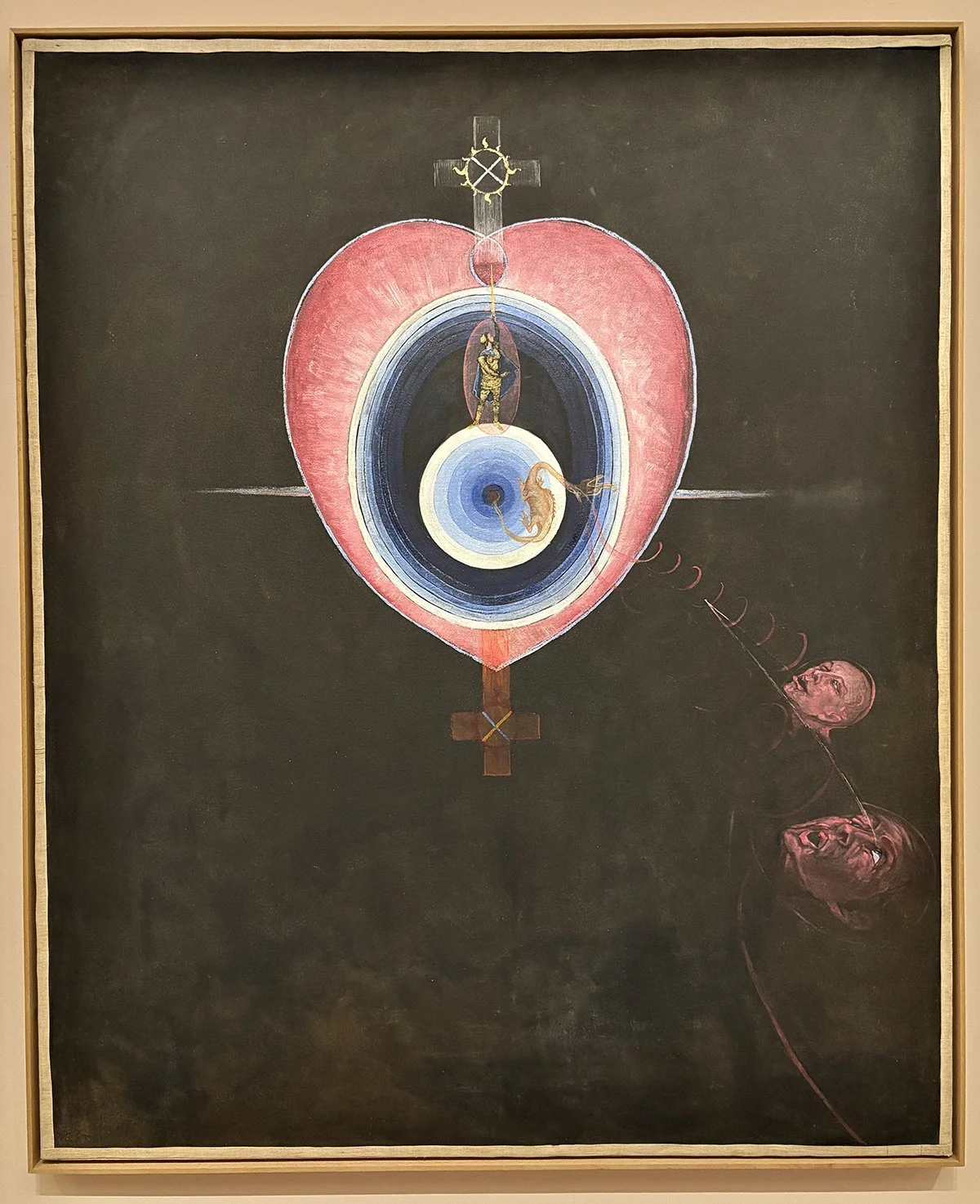
The third painting brings us back to the night, the pink heart once again floats upon a dark ground, but something has tightened, for the dragon, become golden and almost frail, circles around a black point at the center of the white disk, the knight above it seems to hold back his blade rather than brandish it, and the two heads, larger, closer, more alive than ever, climb back along the spiral toward the heart, their mouths open, as though that which had been expelled refused its exile.
What is given to be seen here, it seems to me, is no longer quite a combat, it is a tension. Everything in the image works by pairs, the upright cross and the inverted cross, the black of the ground and the pink of the heart, the knight above and the dragon below, and even these two heads that follow one another along the coil, so that one might say, in dialectical language, that thesis and antithesis face each other without either managing to prevail. Jung gave a name to what the psyche may hope for in such an impasse, the transcendent function, that capacity, which cannot be commanded, to let emerge from the tension of opposites a third term, neither the one nor the other, which does not resolve the binary problem but surpasses it by giving it a new path. The painting does not yet show this third term, and perhaps that is its very rightness, it shows the waiting, that moment in which one must hold the contraries together without yielding to the temptation of sacrificing one of them, and in which the black point at the center of the disk, minuscule, might well be the seed of what is to come.
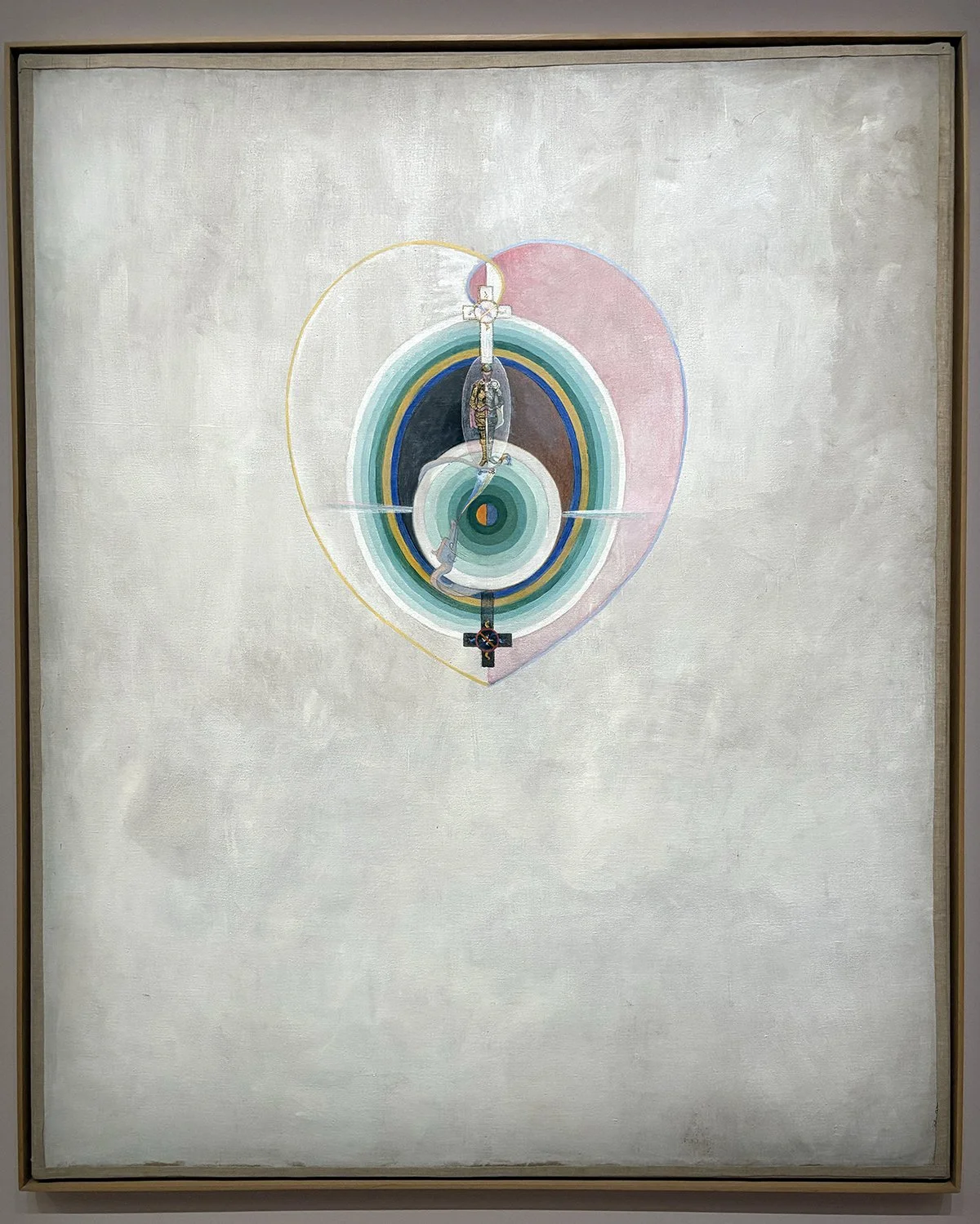
Photo © Yury Li-Toroptsov
The fourth and final painting is bathed in light, for the black ground has made way for a milky white that fills the whole canvas, the heart itself has divided into a clear half, simply ringed with gold, and a pink half, the spiral and the heads have vanished, and at the center of the green and golden rings the knight stands peacefully upright at the summit of the disk, while the dragon, pale and appeased, rests at his foot, coiled around the base of the circle, and at the exact point of the center there appears a small sphere divided into two halves, one orange and the other blue.
It is difficult not to read here a resolution. The tension of opposites that carried the first three paintings seems to have come undone, not through the victory of one camp over the other, but through their common transformation, for Saint George and the dragon are still there, both of them, but under a new form, transfigured, the knight with no blade any longer brandished, the dragon with no menace any longer, reunited within the same enclosure as the integral parts of an equilibrium that surpasses them, in the manner of yin and yang, and the small two-colored sphere at the center, half warm and half cold, might well be the image of that third term which the preceding painting allowed us to hope for, the transcendent function become visible. The war is over, not because the adversary has been annihilated, but because he has found his place. Psychologically, one might think of what a person lives through when emerging from a long depressive episode, when that which was crushing him does not disappear so much as it ceases to crush him, becomes part of his history, integrated, and the world, losing nothing of its gravity, recovers its light. Af Klint, who painted this series in the midst of the First World War, surely knew what such a peace is worth, and how it is won.
There remains a question, which the reader is entitled to put to me. Why call this spirituality, when everything that precedes belongs, it would seem, to psychology? It is that the two cannot be separated as easily as our age would wish. The word psyche, one recalls, means soul, and the reading we have just carried out has never ceased to speak of something other than mechanisms, for what is at play in these four paintings, the night traversed, the tension held, the third term that arrives without being fabricated, is not the product of a will but the experience of being visited by something greater than the ego. Af Klint said it in her own way, attributing her works to higher intelligences, and Jung will say it in his, speaking of the numinous and of the Self, that center of the personality which overflows consciousness on every side and of which the ego, like the little golden knight in the immensity of the canvas, is never more than the humble counterpart. The spiritual dimension perhaps begins exactly there, not in a belief, still less in a doctrine, but in this lived experience of a dialogue with that which surpasses us within us, and of which the dove that gives the series its name, a spirit hovering above the combat, would be as it were the discreet signature. If the psyche is the place where this dialogue comes about, then to study the soul and to open oneself to the spirit are the two gestures of a single attention, and it is this attention, more than any chronology, that af Klint's paintings await from us, patiently, for more than a century now.