A visit of a seminal exhibition at the Swiss National Museum in Zurich
It is a strong exhibition, and walking into the Landesmuseum that morning I felt a quiet respect for the way Switzerland protects its cultural inheritance, not as something decorative or nostalgic, but as a living archive of ideas and practices, among which its contribution to psychology, with figures such as C. G. Jung, Hermann Rorschach, and others, holds a central place.
We were received by Stefan Zweifel, the curator of the exhibition, who guided us through the rooms with a precision that never felt academic, and whose tour made one thing clear from the start, this was not an art show in the usual sense, but an exploration of how inner life has sought form, structure, and visibility, long before it found stable concepts or clinical language.
Landscapes of the Soul presents art as a mode of inquiry, and as I followed the path of the exhibition I had the impression of moving through a sequence of inner territories made visible, where paintings, notebooks, diagnostic tools, and drawings created in clinical contexts coexist in the same space, as if to insist that the psyche does not remain abstract, that it insists on shaping itself, again and again, into images.
There are the inkblots of Rorschach, no longer reduced to a testing device, but restored to their ambiguity and visual force, reminding the viewer that projection is not an error of perception but one of its core operations, the place where meaning is produced rather than received. There are drawings from psychiatric clinics, fragile and often unsettling, yet marked by an internal logic, as though the mind, even in states of rupture, continues to compose, arrange, and organize experience when language no longer holds. There are landscapes, interiors, and recurring symbolic motifs of ascent, enclosure, and passage, appearing across different hands and periods, suggesting that inner life, while singular, follows patterns that are shared, transmitted, and transformed.
At the center of the exhibition stands C. G. Jung’s Red Book, given a prominence that feels both natural and necessary, and standing before it I was reminded that this object is neither a theoretical treatise nor a diary in any conventional sense, but the trace of a long and deliberate turning toward the depths of the psyche. Between 1913 and 1930, Jung recorded his inner encounters through calligraphy, painting, and symbolic scenes, creating a private laboratory in which figures, voices, and visions were not dismissed or reduced, but observed, shaped, and engaged with, until what would later become analytical psychology first took form not in concepts, but in images.
What struck me most was the risk contained in this work, the decision to trust form before explanation, experience before system, and to allow meaning to emerge through repetition, symbol, and sustained attention, without forcing it into rapid conclusions. In front of the Red Book, the psyche does not appear as a problem to be fixed, but as a landscape to be traversed, with patience, discipline, and a readiness to be altered by what one encounters along the way.
When I left the exhibition, what remained was not a single image but a conviction, inner life is neither vague nor formless, it leaves traces, builds structures, and demands a language of its own, and art, in this context, does not serve psychology as an accessory, it operates as one of its most precise instruments, a way of thinking through the eye when words fall short.
Above you will find a podcast episode dedicated to this exhibition to explore these questions in more depth, and in the meantime, if you happen to be in Zürich, do not miss Landscapes of the Soul.
I am deeply grateful to Denise Tonella and Stefan Zweifel for their warm welcome.
Landscapes of the Soul
C. G. Jung and the exploration of the human psyche in Switzerland
17.10.2025 - 15.02.2026
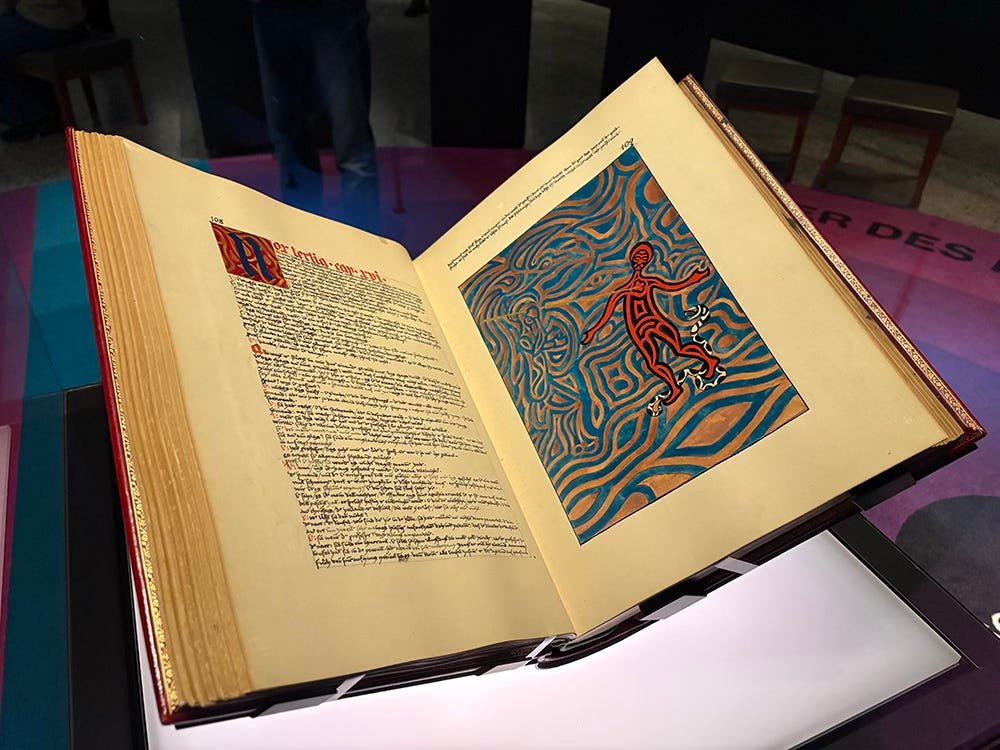
CG Jung’s Red Book (Liber Novus) on display at Landesmuseum Zurich. Photo by Yury Li-Toroptsov