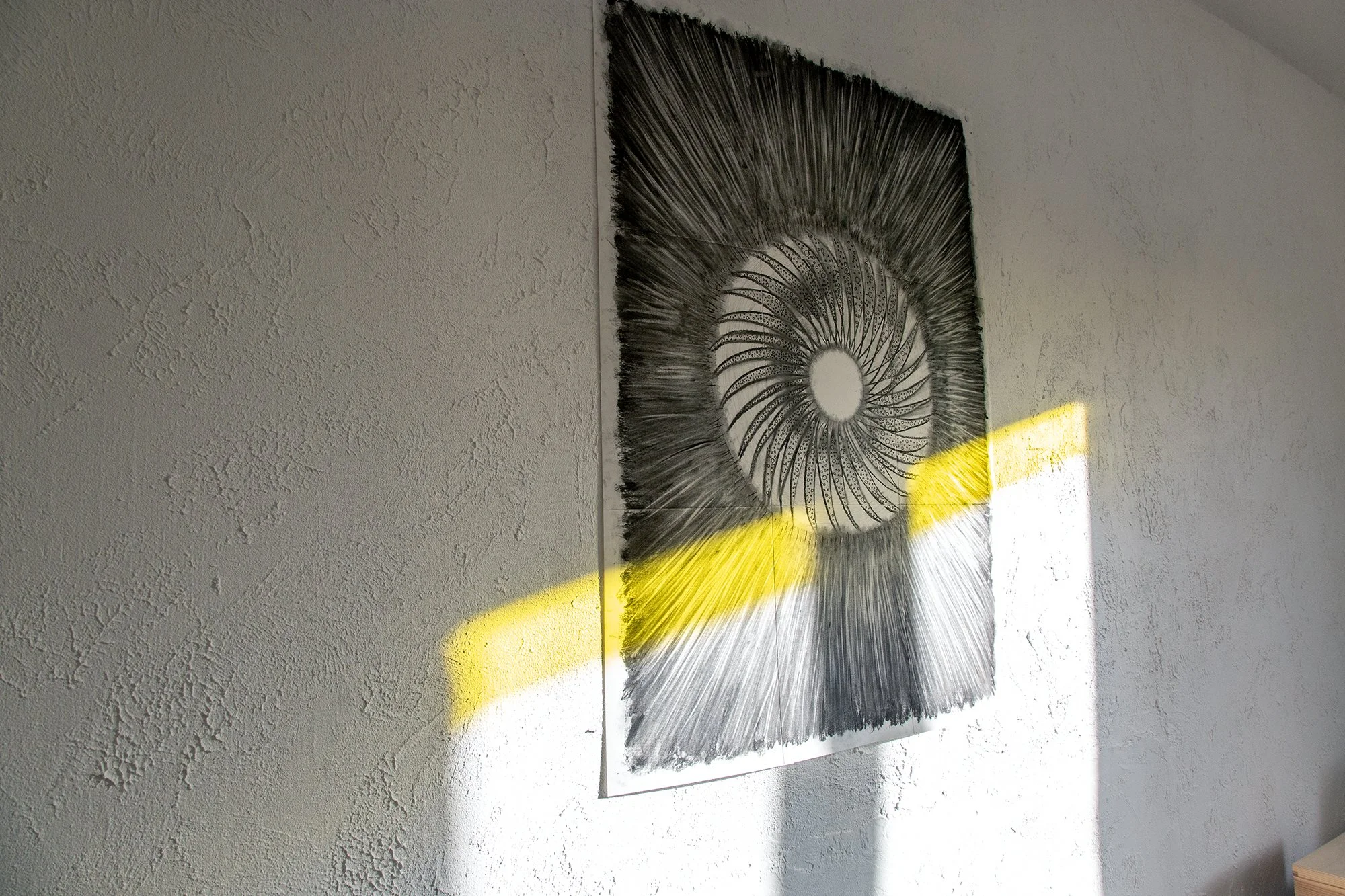
Photo © Yury Li-Toroptsov
It’s a sunny morning in Paris, and I’m getting ready to go out. I’m meeting a client for a coaching walk around my artist studio in the 11th arrondissement. Thankfully, the weather is cooperating—we’ll be taking pictures.
I am a visual artist and a professional coach, currently training at the C. G. Jung Institute Zurich to become a Jungian analyst. I believe that the images we create serve as a condensed expression of our relationship with both our inner and outer worlds. At least, that’s the theory.
In his commentary on The Secret of the Golden Flower: A Chinese Book of Life (1931), the Swiss psychiatrist Carl Gustav Jung (1875–1961) wrote:
“It is as if we did not know, or else continually forgot, that everything of which we are conscious is an image, and that image is psyche.”
Jung even connects the concept of image with consciousness itself. But what is it that, according to Jung, we once knew but have somehow collectively forgotten? I feel he is speaking, among other things, about our diminishing capacity to think symbolically. Today, we tend to interpret everything literally, losing the ability to engage with symbols and images. Why does that matter? Because symbols create meaning for us.
American Jungian analyst and author Robert A. Johnson said:
“Modern society has lost the power of symbolic life, though we have not escaped our need for it.”
We need meaning in our lives and work—without it, we disengage. Symbols help us sustain that meaning, especially in times of crisis. One might argue that the greatest crisis we face today is a crisis of meaning.
We live in a world saturated with images—around five billion photos are taken each day. We all snap pictures with our smartphones, but do we ever stop to consider what those images truly mean? Because of the smartphone’s ubiquitous nature, I use smartphone photography to help people establish or deepen their inner dialogue through image work.
One coaching client came to me with a professional difficulty. He felt forced into early retirement from an ad agency against his will. Though he had accepted the retirement, he struggled to process the emotions surrounding it. Since he was a creative, I suggested we go on a photo walk around my office. His only task was to photograph anything that caught his attention.
Back at the studio, reviewing the photos on his smartphone, I noticed some striking images: dog poo on the sidewalk, street litter, traces of urine on the asphalt. These graphic images encapsulated his frustration, giving concrete form to a range of emotions and his anger in particular, which until then he had been unable to express. These images opened the door to a deeper discussion.
Are all images equal? In Psychological Types (1921), Jung describes different kinds of images: primordial, archaic, or archetypal images; fantasy-images; personal images, and more. These categories relate to Jung’s understanding of the psyche, which includes both personal and collective levels.
To me, the most precious images are the ones born in the cauldron of the soul. This brings us to the notion of imagination. You may have already noticed that image is embedded in imagination. Imagination is a natural function of a well-regulated psyche. Everyone is creative by default. Sometimes, though, we lose touch with our innate flow of creative energy, and our lives change as a result. Imagination can diagnose what isn’t working and create solutions. That’s why it is crucial to keep our imagination alive.
I take all my clients on the same itinerary around my neighborhood. Everyone, including today’s client, sees and photographs the same neighborhood. Yet, I have never seen two identical photos taken by the clients. Our shared geographical locations may be identical, but the stories we tell ourselves about them shape entirely different inner realities and mindscapes.
* Carl Gustav Jung. The Collected Works of C. G. Jung: Revised and Expanded Complete Digital Edition. Princeton University Press. 2023. p. 3851.