Photo by Yury Li-Toroptsov
What if we read this image not as a map of the afterlife but as a vision of the inner world?
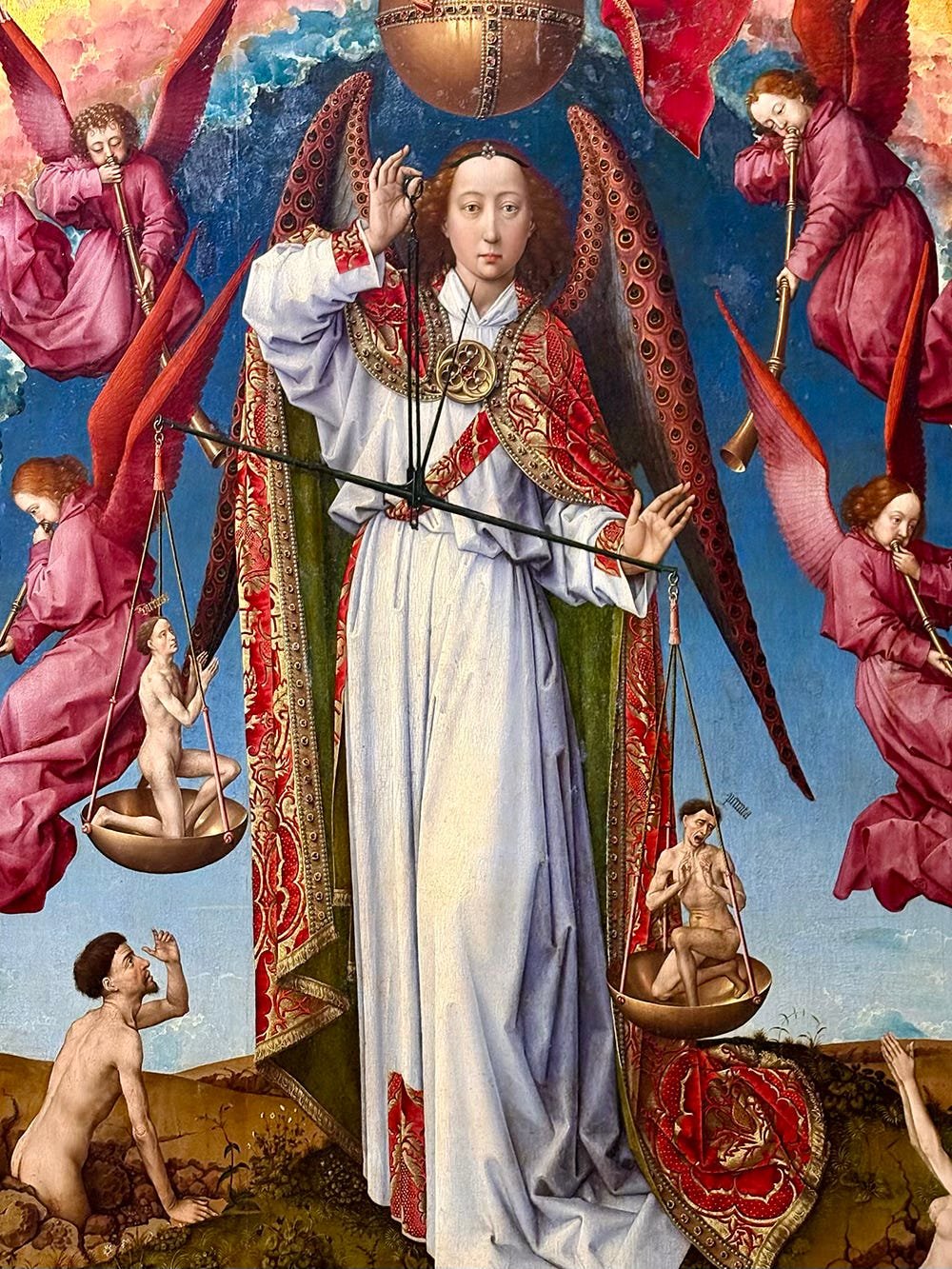
I have just revisited Burgundy and while in Beaune went to see Rogier van der Weyden’s Last Judgement, one of the most haunting works of the Early Netherlandish period. Created around 1445–1450 for the Hôtel-Dieu in Beaune, a hospice for the poor and the dying founded by Nicolas Rolin, this immense polyptych was meant to confront those nearing the end of life with a vision of the world to come.
When the panels are opened, the viewer faces a sweeping cosmic drama. At the center, the Archangel Michael weighs souls on a delicate balance. Above him, Christ sits in judgment, flanked by the Virgin Mary and John the Baptist. On one side, the blessed rise toward a radiant heaven, welcomed by angels. On the other, the damned descend into a dark, fiery abyss.
At first glance, the composition seems to separate Heaven and Hell as if they were distinct geographical zones. Heaven is an ordered garden of light, while Hell is chaos and darkness. Yet van der Weyden does something remarkable: there are no demons in his Hell. The inferno is populated entirely by human figures. The painter implies that damnation is not inflicted by monstrous forces but is a purely human affair.
This is a profound moral statement. Good and evil appear as opposing instances, two clearly delineated territories. One strives upward, the other collapses downward. But what happens if we change the lens? What if we read this image not as a map of the afterlife but as a vision of the inner world?
Seen intrapsychically, the Last Judgement becomes a portrait of the human psyche. The radiant and the tortured figures coexist within the same being. The Archangel Michael’s scale does not weigh others’ souls, but ours. Heaven and Hell are no longer separate realms but two poles of one psychic field. The light of consciousness and the shadow of the unconscious are both present, both alive.
Here emerges the idea of wholeness. The painting becomes an image of the Self striving for balance, not victory. Wholeness does not mean purity or perfection. It means the capacity to contain contradiction. To recognize that within each of us dwell both the figures of ascent and those of descent.
It is our responsibility, then, to identify our personal Heaven and our personal Hell, our solar and lunar sides. When we look at van der Weyden’s image through this lens, the boundaries blur. The good are not simply on the left, nor the bad on the right. The painting no longer divides; it integrates.
Aleksandr Solzhenitsyn once wrote, “Gradually it was disclosed to me that the line separating good and evil passes not through states, nor between classes, nor between political parties either — but right through every human heart — and through all human hearts. This line shifts. Inside us, it oscillates with the years. And even within hearts overwhelmed by evil one small bridgehead of good is retained. And even in the best of all hearts there remains … an un-uprooted small corner of evil.” Rogier van der Weyden, five centuries earlier, painted that line.
For C.G. Jung, consciousness begins precisely at this crossing point. To become conscious is to stand between opposites and to hold their tension without collapsing into one side. It is to acknowledge both the light and the shadow, both the saint and the sinner, and to live in dialogue with them. Consciousness, in this view, is not a state of moral clarity but an act of reconciliation. It is born from the struggle to unite what was split apart.
Van der Weyden’s altarpiece can thus be read as a symbolic image of this inner work. The Archangel’s scale becomes the image of consciousness itself, weighing, judging, but above all holding together the opposites within one frame. Heaven and Hell are not destinations, but directions of the soul.
To look at this painting is to glimpse the drama of wholeness, the eternal weighing that defines what it means to be human.