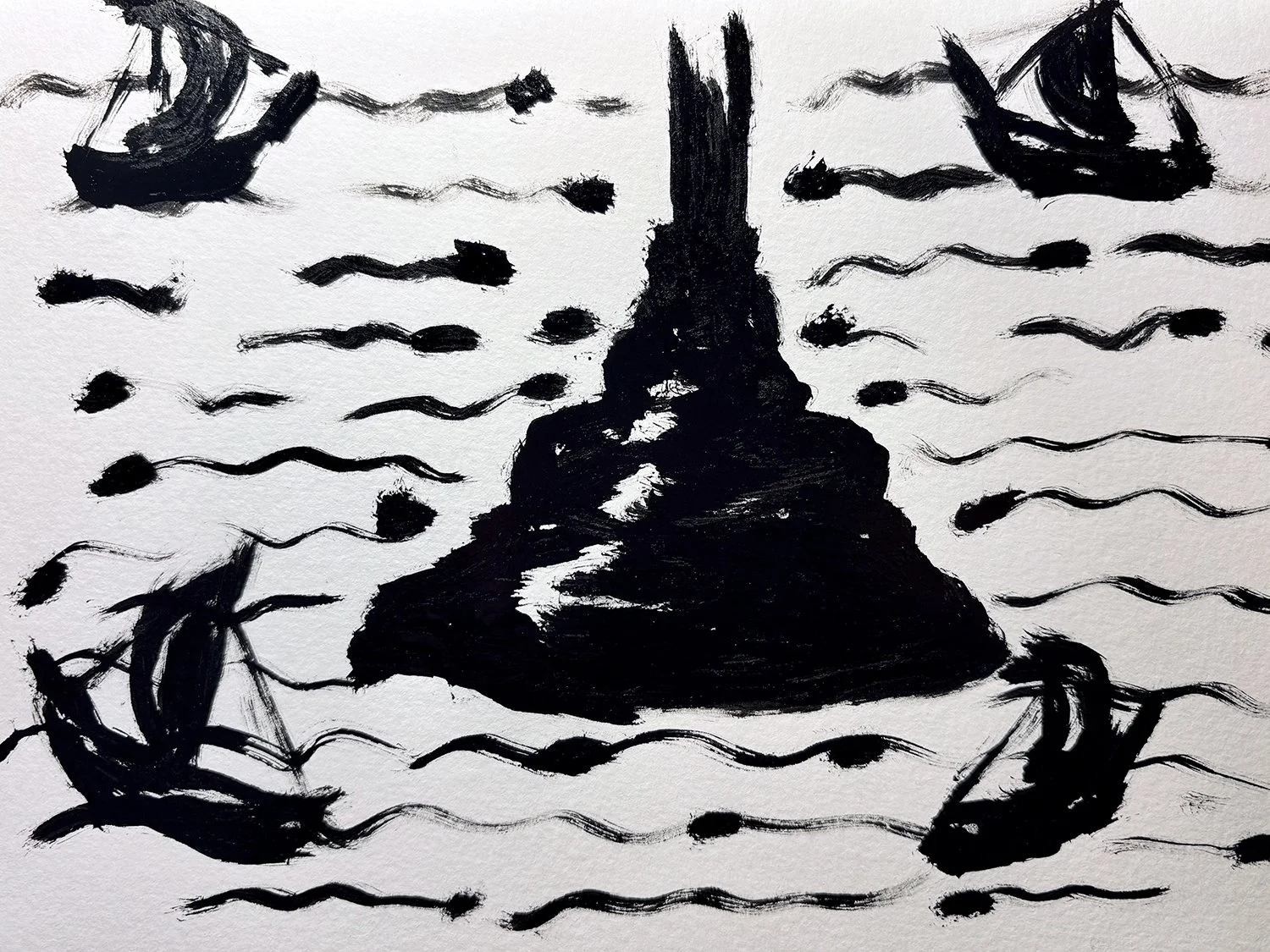
Drawing © Yury Li-Toroptsov
Picturing the business in 2027
There is a strange silence in the air in the French business sector these days. Companies seem to be holding their breath, afraid to make bold moves and saving their budgets for the worst. This is not only a feeling, since the numbers are not good either. According to Insee, France has recorded no growth since the start of the year, and political uncertainty weighs on business activity. Many executives say they fear that the outcome of the 2027 presidential election could mean a complete overhaul of the way they operate.
These macroeconomic figures and predictions are neither new nor sudden, though, and this atmosphere has been in place for some time now. The interesting question is what managers do with this information in mind.
Each member of an executive committee holds a private version of the future, and these versions are rarely confronted with one another, because people talk a great deal in such committees without always saying what they think. The silence in question here does not come from an absence of speech, it comes from the absence, within that speech, of what really matters. In a period of ambiguity, the true resource of a leadership team is not information, of which it has more than enough, but the capacity to say aloud what each member really expects and fears, and to discover where those expectations diverge before the market makes the discovery on its behalf.
The usual tools and their common limit
The instruments that leadership teams usually reach for in such moments are the strategy offsite, the scenario exercise and, increasingly, individual executive coaching. Each of them has real merits. Their common weakness, in my view, is that they all depend on speech, and speech under uncertainty poses two problems. The first is that it is already censored before it is even uttered, since each person weighs what superiors and peers will make of their words. The second is that verbal presentation favours the most articulate, so that the tentative, half-formed perception, which is often the most useful early signal, is the least likely to be heard.
Images let a team say what it cannot yet formulate
Coaching par l’image®, the method I created, rests on a simple observation, namely that a leadership team can often show a situation before it is able to state it. Where a verbal round table produces positions already filtered by prudence and hierarchy, working through images gives each member a way of expressing a perception that is still half-formed, without having to commit to a statement that colleagues could quote back to them later.
One could object that an image must also be commented on in front of the same colleagues. The difference is that the image comes first and that speech then bears on it, and not on the person who produced it, which allows the group to examine a perception together without anyone having had to defend it as a position.
In practice, over one or two sessions, each member of the committee produces an image, whether a photograph taken with a smartphone or a spontaneous drawing, in response to a simple question, for example what the company looks like in 2027. The images are then viewed side by side, and it is most often at this moment that the gaps between visions appear, where a round table would have smoothed them over.
I draw on my training in the Jungian tradition, in which the symbolic image is understood as the earliest form in which a perception that is not yet conscious becomes available to thought. Picturing the business in 2027 then means, quite literally, putting it into images, so that the team knows where it agrees and where it diverges before it decides.