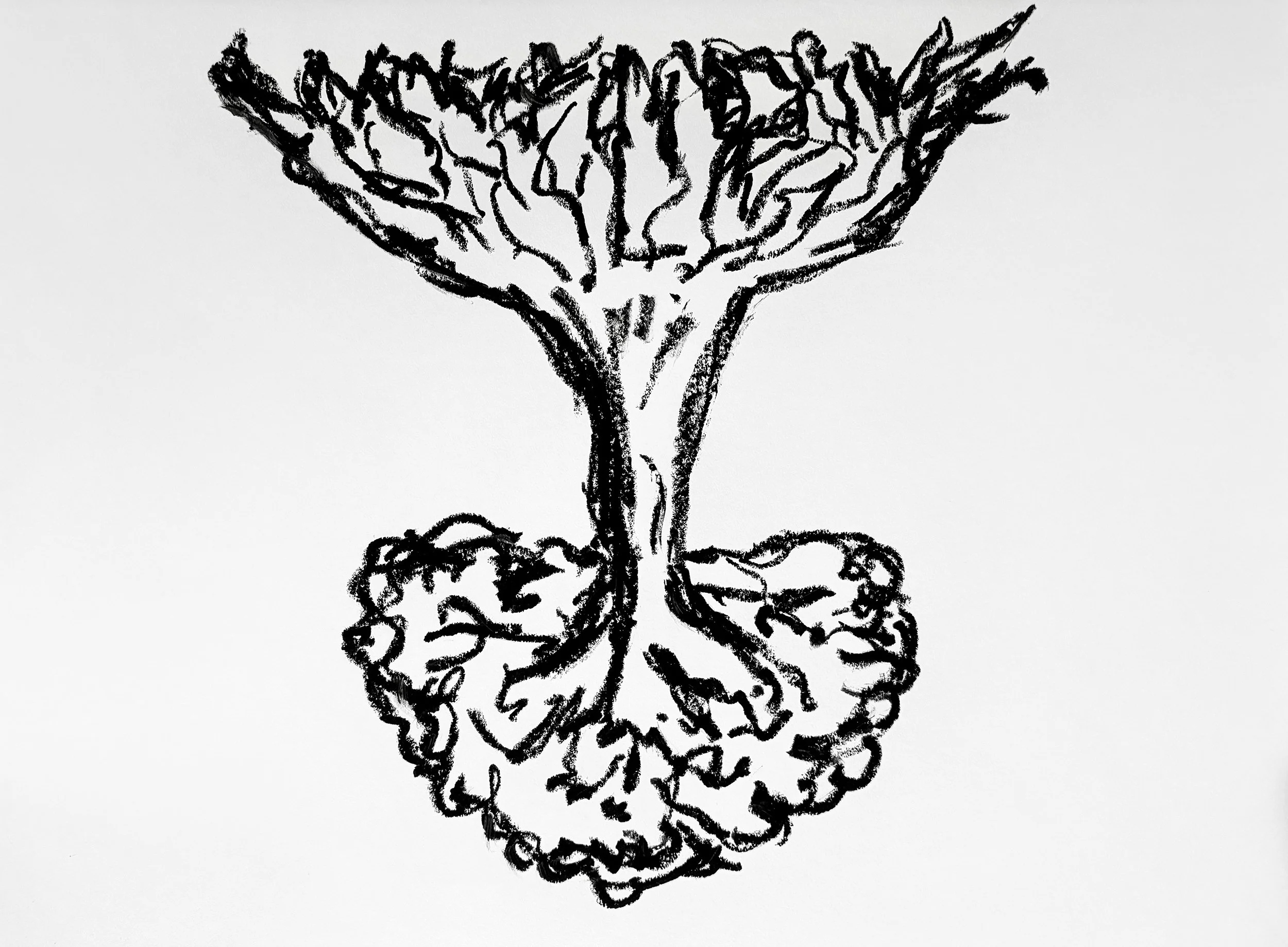
Drawing © Yury Li-Toroptsov
There is a particular kind of exhaustion that has no obvious cause. The career has delivered what it promised. The title is there, the compensation is there, perhaps the corner office or its remote equivalent. The person sitting inside all of this has done, by any external measure, what they set out to do. And yet something has gone quiet inside, not dramatically, not all at once, but persistently, the way a low-grade sound disappears and you only notice it once it has stopped. What felt like direction now feels like inertia. The next project fails to kindle anything. The question that surfaces, sometimes in the middle of a committee meeting, sometimes at three in the morning, is deceptively simple: is this it?
This is not a crisis in the clinical sense, though it can become one. It is something older and, in many traditions, more structurally necessary than that. It is the experience of arriving at the ridge, the high point that was the destination, and discovering that the view from there is not what the ascent promised. The word midlife has been trivialized into a kind of cultural joke, reduced to sports cars and affairs and the embarrassments of men in their fifties trying to recover something they imagine they have lost. But underneath the caricature lies a real and serious psychological event, one that the depth psychologists of the twentieth century took seriously precisely because it could not be resolved by more of what produced it.
What got you here will not get you over there
The first half of an executive life is structured around what the Jungian tradition calls the heroic project: the construction of a capable, effective, socially recognized “ego”. This is legitimate and necessary work. To build a career of real consequence, to lead organisations, to develop judgment and authority, these are genuine achievements, and they require sustained investment of will, ambition, and energy. The first half of life is outward-facing by design. Its logic is expansion, accumulation, mastery. Its currency is achievement.
The problem is that the strategies that work for the ascent are precisely the wrong tools for what comes after it. The executive who has built a professional identity on the basis of decisiveness, performance, and forward movement will find, at some point in their forties or fifties, that these same qualities begin to produce a kind of inner poverty. The relentless orientation toward goals leaves no room for the questions that have no goals attached to them. The habit of productivity becomes, in the interior life, a form of avoidance. What was adaptive becomes a defence.
Carl Jung named this dynamic clearly. The person who has invested everything in the first half's project of outer construction eventually encounters what he called the individuation imperative, the demand, arising from within rather than from the external world, to turn inward and attend to what has been left behind. The “ego” that performed so effectively in the boardroom has often done so by suppressing other parts of the personality: the contemplative dimension, the aesthetic sensibility, the capacity for uncertainty, the relationship with one's own vulnerability. Midlife is when the bill for those suppressions arrives.
The rite of passage and what it requires
In traditional cultures, transitions between major life phases were marked by rites of passage, and those rites had a structure that anthropologists have documented across remarkably different societies. The structure involves three stages: separation from the old identity, a liminal period of disorientation and transformation, and incorporation into a new way of being. What is essential to understand is that none of these transitions is painless, and the central one, the liminal phase, cannot be bypassed or accelerated. It is a period of not-yet, in which the old identity has been relinquished and the new one has not yet taken form.
Contemporary executive culture is almost entirely unprepared for this structure. It does not accommodate liminality. It treats uncertainty as a problem to be solved, disorientation as a failure of leadership, and inner questioning as a distraction from performance. The executive who arrives at midlife asking difficult questions about meaning has no institutional language for what is happening, and no professional permission to explore it. The organisations they lead need them to be decisive and projecting confidence; their peers are unlikely to name what they themselves may be experiencing; and the coaching or consultancy industry that surrounds them tends to offer productivity tools and goal-setting frameworks, which is to say, more of the first half's medicine for a second half's illness.
What the rite of passage requires, at its centre, is sacrifice in the original sense of that word: the willingness to give something up, to let something that was once central become secondary. For the executive at midlife, this is rarely about giving up material success. It is about giving up the identity that was built around the pursuit of it. The person who defined themselves through achievement must find out who they are when achievement is no longer the primary organising principle of their life. This is a genuine loss, even when it is also a liberation, and it cannot be reasoned away or reframed into positivity.
The second half as reversal, and the return of the unlived life
If the first half of an executive life is characterised by expansion, the second half calls for a movement that is not its continuation but its opposite. Not contraction in the sense of diminishment, but depth in place of breadth, presence in place of acceleration, interiority in place of performance. The Jungian reading of this is that the psychic energy that was directed outward must now be redirected inward, not as retreat from the world, but as the beginning of a different relationship with it.
Jung introduced a concept that is quietly devastating in its accuracy for this population: the unlived life. The idea is that in choosing one path, we necessarily leave others untaken, and that the energy belonging to those unchosen paths does not simply disappear. It accumulates. It waits. At midlife, it begins to press back, often with an insistence that can feel irrational or disruptive precisely because the conscious mind has no category for it. The executive who inexplicably finds themselves moved by painting, or preoccupied with a question they set aside at twenty-five, or drawn to a way of living that bears no resemblance to their current one, is not having a breakdown. They are hearing from the unlived life.
This is not a nostalgic phenomenon, though it can be confused with nostalgia. It is not about what was lost but about what was never given room to exist. The first half's demands are real and the choices made to meet them were often necessary, but those choices had costs that only become visible from the ridge. The question that the second half poses is not how to recover what was abandoned, but how to integrate what was deferred. And that is a fundamentally different kind of question from the ones that built the career.
Several things tend to surface in this reversal. Questions about legacy, certainly, but not in the strategic sense that corporate culture uses that word. Questions about relationship, about what has been neglected in the pursuit of professional goals. Questions about mortality, which midlife makes impossible to keep abstract. And, almost universally, questions about authenticity: the growing sense that the life being lived is not quite the life that belongs to this particular person, that somewhere in the successful construction of a career, something essential about who one actually is has been set aside and is now insisting on being heard.
The executive in the CODIR: the view from the summit
Consider the executive who arrives, finally, at the table they spent years working toward. The Comité de Direction, the Executive Committee, this was the destination. The membership in it was the proof that the project had succeeded. And for a time, perhaps a significant time, the arrival delivers what it promised. There is real satisfaction in operating at that level, in having the authority and the scope that come with it.
But something changes. The projects multiply, and the energy to animate them thins. New initiatives require the same investment of will that earlier ones generated naturally, but something has to be manufactured now that used to be spontaneous. The meetings feel repetitive not because they are necessarily different from earlier meetings, but because the frame of reference from which they are experienced has shifted. The executive is still performing the role, possibly performing it well, but there is a growing gap between the performance and the person performing it. The question that cannot be asked in the meeting, why bother, is the question that most needs to be explored somewhere.
This is not laziness or ingratitude or a clinical depression, though it can be confused with both. It is the beginning of the individuation process pressing against the confines of a life that was built for the first half's logic. The discomfort is structural, not incidental. It will not be resolved by a better strategy or a new challenge or a longer holiday.
What can be done: several directions
The first and most important thing is to recognise what is actually happening. The executive facing this experience is not failing, not burning out in the ordinary sense, and not in need of being fixed. They are in the middle of a necessary transition that, if navigated consciously, leads to a genuinely different and, most accounts suggest, richer relationship with one's own life and work. The reframing is not cosmetic: it changes what kind of response is appropriate.
One direction is the deliberate cultivation of reflective practice as distinct from productive activity. This means creating time and space, not to solve problems, but to be present to one's own experience without immediately instrumentalising it. Many executives have never done this in any sustained way. The encounter with one's own interiority, after decades of outward orientation, can be disorienting and is also often surprisingly generative.
Another direction is the conscious engagement with the unlived life. This requires a particular kind of honesty, the willingness to ask not only what one has achieved but what one has systematically avoided, deferred, or suppressed in the process. The unchosen paths are not always dramatic. Sometimes the unlived life shows up as a persistent interest that never received permission, a relational quality that was considered incompatible with professional authority, a mode of being in the world that did not fit the identity being constructed. Naming these things, even tentatively, begins to release the energy that has been locked in them.
A third direction is a conscious examination of the relationship between identity and role. The executive who has fused who they are with what they do will find this fusion increasingly uncomfortable in the second half of life. The work of distinguishing the two, of discovering what remains when the title and the function are held at a slight distance, is some of the most important inner work available at this life stage.
On accompaniment through image
Each of these directions has in common that they require access to parts of the self that rational, language-based analysis alone does not easily reach. The interior life at midlife, and particularly the unlived life, tends to communicate in images, in felt senses, in associations and memories rather than in arguments and plans. This is one reason why approaches to accompaniment that work through symbolic and sensory means, photography, spontaneous drawing, the manipulation of visual materials, can be particularly well suited to this life moment.
The act of making an image, whether by pointing a camera or by moving charcoal across paper, bypasses the executive's highly developed capacity for verbal articulation and conceptual control. It creates a different kind of evidence, evidence of what the person actually perceives and values, rather than what they think they should perceive and value. A photograph taken on instinct, a drawing made without a plan, can surface dimensions of inner experience that hours of structured conversation might not reach. The unlived life, which by definition has never found verbal form, is sometimes more legible in a spontaneous image than in any amount of careful reflection. In this sense, image-based accompaniment is not a softer or more marginal form of coaching; it is, for this particular population at this particular life stage, a more direct route to the material that actually needs to be worked with.
The midlife executive does not need another framework for optimising performance. They need a space in which the questions that performance has been keeping at bay can finally be heard.