Why Small Group Work Matters More Than Ever
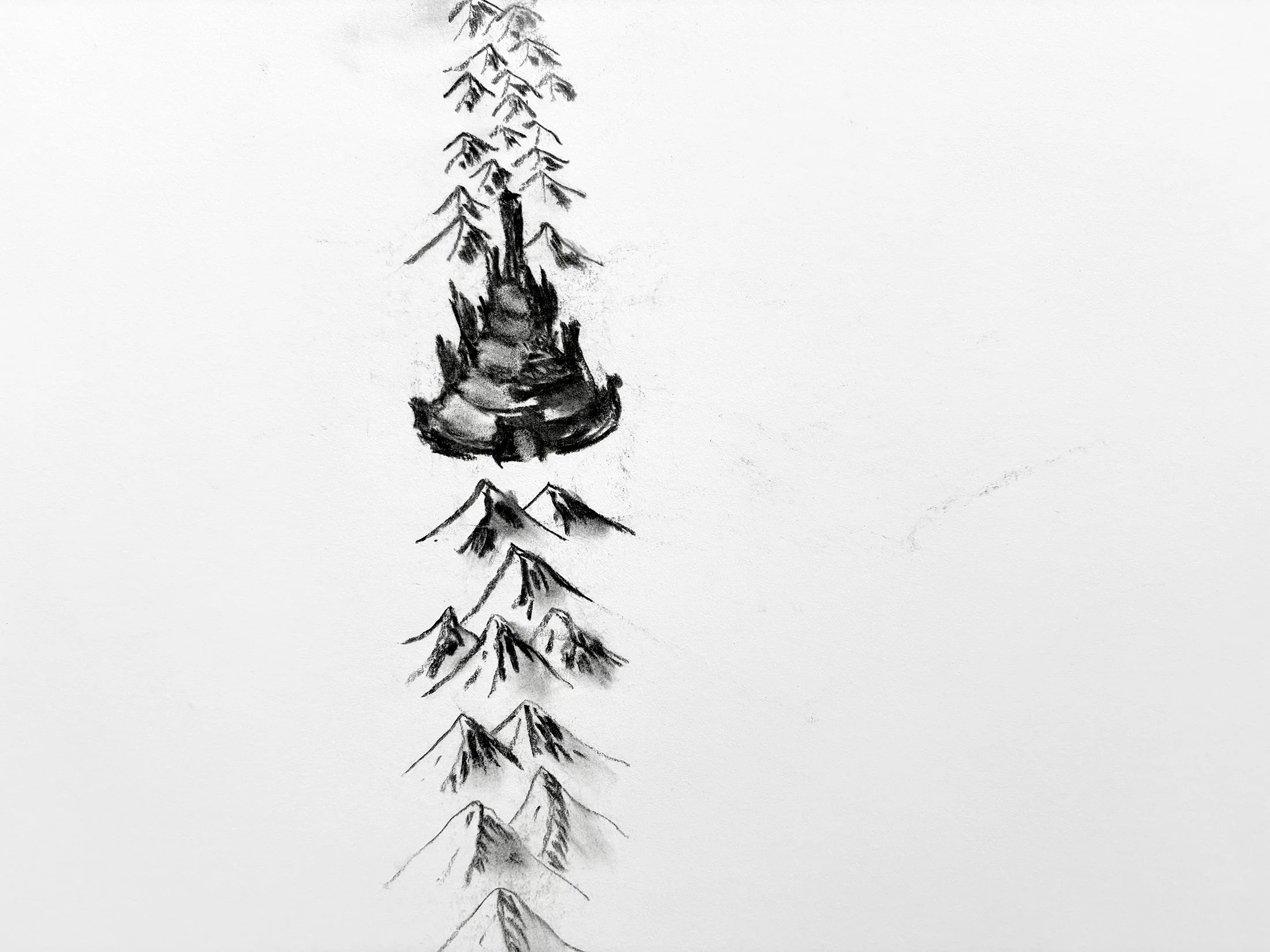
Drawing © Yury Li-Toroptsov
I have just returned from the Belloc Abbey, picturesquely located in the Basque Country, where Espace Jungien Francophone held its first colloquium dedicated to artificial intelligence and depth psychology. I had the honour of giving an experiential workshop there, and this work confirmed once again a conviction that has become central to my practice: we need to do more group work today, not because groups are simple or naturally harmonious, but because the collective space around us has become so inflamed that we need smaller places where people can still speak, listen and remain in relation.
From a Jungian perspective, this is not obvious. C. G. Jung did not place naïve faith in groups. For him, the collective, both consciousness and unconscious, belongs to a supra-personal level of psychic life. It is larger than the individual ego, and it is not something we can simply correct through goodwill or direct intervention. Jung was also cautious about what happens to the individual in a group, because the persona often takes over. We adapt, perform, defend an image of ourselves, and this social surface can block the downward movement toward shadow, ambiguity, vulnerability and unconscious depth.
In this sense, I believe Jung was right. The deepest psychological work still often takes place in solitude, in analysis, in dream work, in artistic creation, or in the private confrontation with oneself. It is there that a person begins to meet the shadow and establish a more honest relationship with the unconscious.
And yet, this is not the whole story.
The collective today is inflamed. Public conversation has become harder, harsher and more fragmented. The shared space in which we once expected to disagree and still remain in relation has increasingly become a place of violent argument, suspicion, hatred and discord. We are losing the capacity to hear the other, especially the other who does not share our views. This is a serious development, because if we lose the ability to listen across difference, we also lose something essential to our capacity to coexist.
My answer to this large question is modest: we must keep talking in small groups.
By small groups, I mean spaces where people gather around a shared concern, a shared task or a shared responsibility, and where it is still possible to encounter one another as human beings rather than as abstract representatives of opposing positions. The audience of the colloquium at Belloc was one such group. An executive committee inside a company is another. A neighbourhood organisation taking care of local youth is another. A mental health nonprofit, like imaRge for example, offering creative workshops to marginalised young people is another. These groups do not heal the collective crisis by themselves, but they preserve something essential: the practice of speaking, listening, disagreeing, repairing, imagining and working together.
In many traditional and collective cultures, this was understood more naturally. Human life was not imagined as a purely individual project in which each person had to manage meaning, suffering, transition and belonging alone. People worked together, celebrated together, mourned together, raised children together and healed together. Rituals reaffirmed the power of the collective as a living container for human experience. The phrase “it takes a village to raise a child” points to this wider understanding of life, where the individual becomes himself or herself through the gaze, care, language, limits and responsibilities of a community.
Individualised societies have lost much of this. We have gained freedom, autonomy and self-definition, but we have also lost many of the shared containers that once helped people metabolise fear, grief, conflict and meaning. As a result, many people now carry alone what was once carried by the group.
We see the consequences clearly in the workplace. Many high achievers, senior managers and leaders of industry know how to perform, decide, persuade and deliver under pressure, yet they often suffer in collective settings. A leader may be brilliant one-to-one and yet become defensive inside a team. A committee may contain highly intelligent people and still fail to develop trust. Meetings may appear efficient while the most important conversations remain unspoken. People may speak from their role but not from their experience. They may protect their perimeter instead of revealing their dependencies.
This creates a costly paradox: organisations filled with talented people who struggle to think together.
In such contexts, group work is not a soft luxury. It is a strategic and human necessity. When a group learns to speak differently, it begins to perceive differently. When people hear what a colleague is carrying, what pressures shape another function, what fears or hopes sit behind a position, the whole system begins to shift. The other becomes more complex. The conflict becomes more intelligible. The collective field becomes less reactive.
We need more deep and soulful work in small groups today. The large collective has become too charged, too abstract and too violent. Many public spaces no longer offer the conditions for genuine thought. But small groups still can. They can still allow us to sit in a room, face one another, listen, risk a word, bear a silence and leave slightly changed by the presence of others.
Every time a small group creates a space of honest speech, mutual attention and symbolic depth, it resists the fragmentation of our time. It protects the possibility of relationship. It reminds us that the other is not only an opponent, a function, a category or a threat.
The other is also a human being.